Capability Modelling
Introduction
Business capabilities describe what an organization is able to do, independent of organizational structure, processes, or applications.
They provide a stable foundation for strategic planning, portfolio management, and transformation initiatives.
This pattern describes a pragmatic approach to capability modelling, using Value Streams to structure capabilities, while deliberately keeping capabilities on a single, flat level to support clarity, consistency, and efficient analysis.
Design Principle
Structure Capabilities by Value Streams, Keep Capabilities Flat
Value Streams provide structure and context.
Capabilities remain on one level to support analysis and comparability.
In this pattern, Value Streams form the structural hierarchy above capabilities.
The Capability concept itself is not decomposed hierarchically.
Modelling Structure
Value Streams - Structuring the Business
Value Streams are used consistently to group capabilities and provide a high-level view of how the business operates from a value delivery perspective. They can be modelled either with or without Triggering relationships. When used, Triggering relationships represent the logical sequence of Value Streams. Their use is optional and depends on whether modelling the flow between Value Streams is relevant for the intended analysis.
Typical examples of Value Streams include:
- Order to Cash
- Idea to Market
- Hire to Retire
- Incident to Resolution
 Value Stream → Triggering → Value Stream
Capabilities - One Flat Level
Capabilities are modelled on a single level, without sub-capabilities.
Each Capability represents a distinct business ability that supports one or more Value Streams.
Typical examples include:
- Order Management
- Billing
- Customer Master Data Management
- Supplier Management
- Financial Reporting
- Capability → Serving → Value Stream
This relationship shows which capabilities serve each Value Stream.
The Pattern
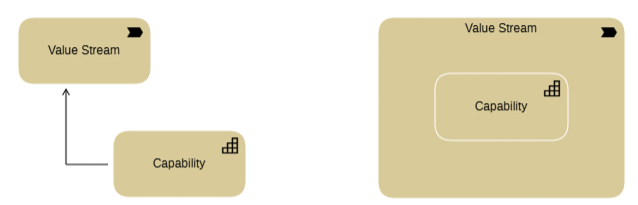
Why This Structure Works
Why Value Streams Above Capabilities
- Provide context without overloading the capability layer
- Reflect how stakeholders think about value creation
- Enable consistent grouping across domains
Why Capabilities Remain Flat
- Simplifies assessments, heatmaps, and dashboards
- Improves comparability across Value Streams
- Reduces modelling and maintenance effort
- Avoids artificial decomposition with little analytical benefit
Example: Capability Modelling for an Airport
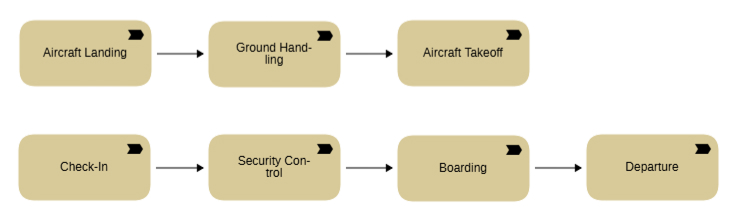
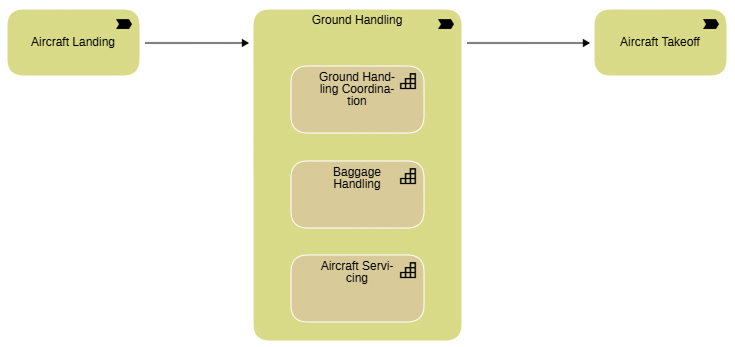
An airport operates multiple value-oriented business structures in parallel.
Two of the most central ones are Aircraft Operations and Passenger Processing.
Value Streams
Capabilities
Do / Don't - Capability Modelling
 Do
Do- Use Value Streams as the primary structuring element.
- Keep Capabilities flat.
- Reuse capabilities across multiple Value Streams.
- Use capabilities as anchors for assessment and planning.
 Don't
Don't- Don't decompose capabilities into sub-capabilities.
- Don't confuse capabilities with processes or organizations.
- Don't enforce triggering relations where no flow exists.
- Don't introduce multiple grouping concepts for the same purpose.
Scope and Intent
This pattern supports:
- strategic planning and prioritization
- capability assessments and heatmaps
- alignment between business and application architecture
It is not intended to:
- model business processes
- describe organizational structures
- replace detailed functional decomposition